
The KW Lawyers Team
In March 2025, the Albanese Government announced plans to crack down on non-compete clauses in Australia. As stated in the official media release, this move was designed to “stop unfair non‑compete clauses that are holding back Australian workers from switching to better, higher‑paying jobs.”
An existing non-compete clause, however, is not voided by the changes announced. This is because the ban will take effect from 2027, in which it will only apply to new contracts and workers earning below the high-income threshold of $175,000.
Until then, whether your clause binds you may depend entirely on the common-law ‘reasonably necessary’ restraint-of-trade test.
What is a non-compete clause, and who does it impact?

Non‑compete clauses (or restraint clauses) are specific conditions included in an employment agreement that prevent or restrict workers from either moving to a competitor or starting a new business in the same industry. The scope and duration of this clause can vary. For example, some agreements apply Australia-wide and ban workers from switching to a competitor for multiple years.
Certain provisions, such as a non-compete clause, are often favoured by employers as a means to protect client relationships, trade secrets, and confidential information. However, as noted in the government’s media release, these conditions can actively prevent employees from earning a higher salary within their industry.
Of course, there are also certain circumstances where a non-compete or restraint clause is an important measure. This primarily relates to highly competitive industries and professions where employees can take existing clients to another company.
Such agreements, being in restraint of trade, are held by the courts to be prima facie void. As such, restraint clauses will only be enforceable if they are found by the Court to be reasonable.
Who is most likely to be impacted by a non-compete cause?
In 2025, over three million Australian workers were covered or bound by a non-compete clause (Australian Treasury). This included employees working in the following industries:
- Childcare
- Construction
- Hairdressing
- Healthcare
- IT & Marketing
Until the newly proposed changes take effect, millions of Australians are still bound by these conditions and provisions. If this applies to you, please keep reading for further advice.
Does anything change for an existing clause, or only from 2027?
The proposed ban does not cancel a clause that you have already signed.
Reforms to non-compete clauses will take effect from 2027, which means they will not apply to past contracts. This timeline has been set out to give both workers and employers sufficient time to adjust.
Because the ban isn’t active until next year, any existing agreements are still subject to the conditions set out now. Most notably, this includes whether or not a restraint clause is considered “reasonable”. We will provide an overview of what this means below.

If you currently have a restraint or non-compete clause and need legal advice, please reach out to us and connect with knowledgeable employment contract lawyers in Melbourne and Brisbane. Contracts of employment can be difficult to navigate, but our legal team is here to guide you through the entire process.
What makes a restraint clause “reasonable”?
‘Reasonableness’ will be established where:
- The employer has an interest to protect (such as confidential information or a unique form of goodwill) and the restriction imposed is no wider than this interest;
- The stated area of restriction is no wider than that in which the employer’s interest might be affected; and
- The period of the restriction is no longer than is needed to protect that interest.
The reasonableness of the restraint must be considered both from the point of view of the parties and also with reference to the public interest. This then becomes a two part test:
- Reasonable between the parties: Reasonableness is determined by its effect in practice. It is judged at the time the parties entered into the contract, taking into account, as far as possible, probabilities and future contingencies and is a question of law to be decided by the court.
- In the public interest: Because restraint clauses are prima facie void, it is up to the employer to first establish that the restriction is reasonable between the parties. If the employer is able to establish that the restriction is reasonable, it is then up to the employee to establish that an otherwise reasonable restraint is contrary to the public interest. Again, this is a question to be decided by the Courts.
How likely is it that a clause will be enforced?
The courts have traditionally been reluctant to enforce restraints of trade imposed on employees, because of the relative inequality of bargaining strength between employers and employees.
As a result, if a restrictive clause is in any way unreasonable, the courts will most likely declare the whole clause void unless the unreasonable part is completely severable by the ‘blue pencil’ test; that is, if the unreasonable part were to be crossed out by a blue pencil, the remainder of the clause would be both reasonable and readable, and able to stand alone.
For this reason, many restraint of trade clauses have a range for the area of restriction (eg a) 1 kilometre, b) 5 kilometre and c) 10 kilometre from the employer’s business and a range for the length of time for which the restriction is to remain in effect (1 year, 2 years, 5 years etc).
On the whole, the Courts recognise an individual’s right to work and will not support clauses that try to unreasonably undermine this right.
Clauses that restrict an employee from poaching clients or other staff are more likely to be enforced. In short, the Court will most likely allow you to set up the Michael Scott Paper Company, but not allow you to hire Pam and Ryan.
What if a non-compete is bundled with other restraint clauses?
In some circumstances, employees may have an agreement that includes multiple restraint clauses. As an example, these can include either non-solicitation, non-disclosure, or a combination of multiple clauses within the same contract.
The following diagram, taken from the Treasury’s 2023 report into ‘Non-competes: a case of missing wages in Australia’ illustrates the prevalence of this in the Australian workforce.
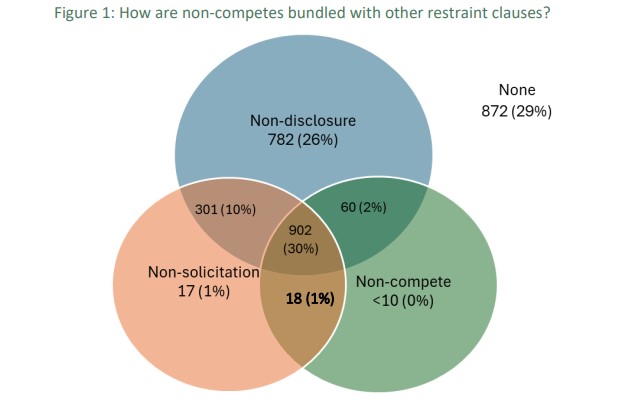
The government has also noted that they will be considering and consulting further on “non‑solicitation clauses for clients and co‑workers, and non‑compete clauses for high‑income workers” (Australian Treasury). As a result, there is certainly a reason to watch this space.
In a scenario where multiple restraint clauses are already in place, the best course of action is to seek legal advice. For workers, it is particularly important to speak with a work contract lawyer as multiple restraints can apply to the same employee agreement.
Can I access legal advice for an existing non-compete clause?
If you have an existing restraint or non-compete cause and want clarity around your options, KW Workplace Lawyers can provide informed and affordable legal advice.
We have workplace lawyers in Melbourne and Brisbane, with accredited specialists ready to help with:
- Contract review and explanation
- Negotiation of improved terms
- Advice on non-compete and restraint clauses
- Redundancy and severance guidance
- Contractor vs employee assessments
Our process is clear, simple, and designed for complete peace of mind. Simply book your consultation today and get expert advice from an accredited employment law specialist.
More Frequently Asked Questions
When should I have my employment contract reviewed by a lawyer?
Ideally, before signing any new contract or when facing significant changes to existing terms. Our employment contract lawyers help if you’re experiencing issues with current contractual obligations or considering resignation with restraints in place.
What makes a non-compete clause enforceable?
A non-compete clause is more likely to be enforceable if it protects a legitimate business interest, such as confidential information, client relationships, or goodwill, and goes no further than necessary. Courts will consider factors such as the duration of the restraint, the geographic area covered, and the employee’s role.
How do courts decide whether a restraint is reasonable?
Courts assess whether the restraint is reasonable between the parties and whether it is consistent with the public interest. The restriction must be proportionate to the employer’s legitimate interests and not impose unnecessary limits on an employee’s ability to work.
What if my contract contains multiple restraint clauses?
Some employment contracts contain a combination of restraints, such as non-compete, non-solicitation, and non-disclosure clauses. Even if one restraint is unenforceable, other provisions may still apply. If your agreement contains multiple restraints, it is certainly advisable to get legal advice before changing employers or starting a competing business.